HSK 2 Vocabulary List: Essential Words to Learn Next
Letsgo Chinese · March 26, 2026 · 18 min read
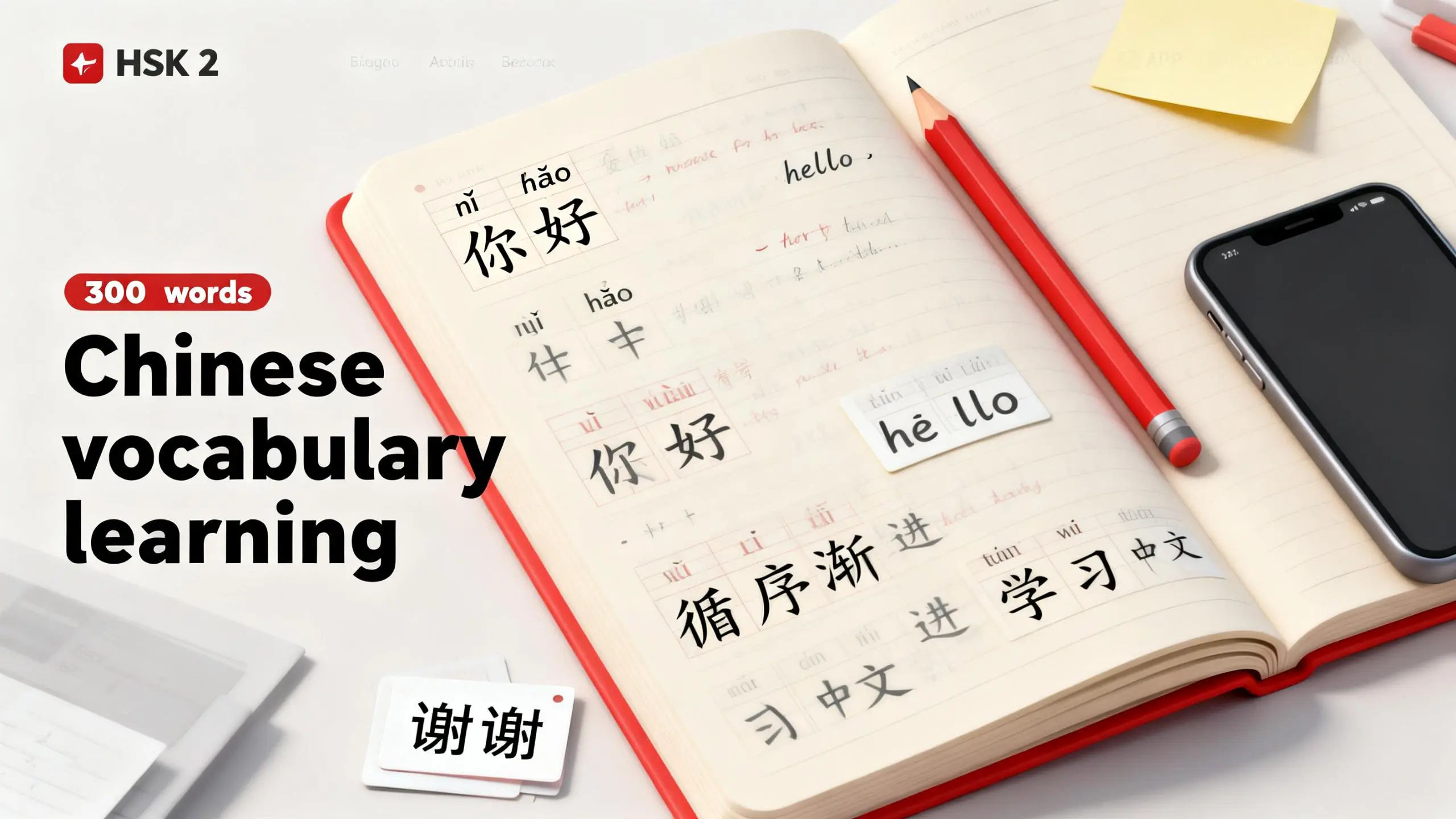
HSK 2 is the next step after the beginner basics. If HSK 1 gets you off the ground, HSK 2 starts making your Chinese feel more usable in everyday life.
In the familiar HSK 1 to HSK 6 path, HSK 2 covers 300 cumulative words. That does not mean 300 totally new words all at once. It means you build on the HSK 1 base and then widen it with more common vocabulary, more short exchanges, and more sentence-building tools.
If you want the bigger picture first, read what HSK is. If your foundation still feels shaky, keep the HSK 1 vocabulary list, pinyin, and the four Chinese tones close while you study this page.
What HSK 2 Actually Means
Most beginners still talk about HSK using the familiar HSK 1 to HSK 6 path. The broader official framework now also includes Levels 7-9, but for search queries like hsk 2 vocabulary list, learners are usually looking for the classic beginner roadmap.
At this stage, you are still a beginner. The difference is that HSK 2 gives you more room to handle normal daily situations without everything feeling brand new.
You are not aiming for advanced Chinese yet. You are trying to widen your basic range so you can:
- talk about more people, places, and routines
- ask and answer short practical questions
- handle common time, travel, food, and shopping language
- connect ideas with simple structures instead of isolated words
What Changes from HSK 1 to HSK 2
HSK 2 is not a dramatic jump, but it is a real one.
| Area | HSK 1 | HSK 2 |
|---|---|---|
| Vocabulary size | 150 core beginner words | 300 cumulative words |
| Daily-life range | Basic greetings and survival language | Wider routines, travel, shopping, time, and simple descriptions |
| Sentence handling | Very short beginner phrases | More short exchanges and practical sentence building |
| Study risk | Memorizing words without sound | Moving too fast before HSK 1 feels stable |
The best way to think about the jump is simple: HSK 1 helps you begin, and HSK 2 helps you function a little more comfortably.
How To Think About the 300 Words
Do not treat HSK 2 like one giant pile of vocabulary.
It is easier to manage when you group the words by how they actually show up in beginner Chinese:
| Category | What it helps you do |
|---|---|
| Greetings and routine expressions | Handle polite basics and short social exchanges |
| People and relationships | Talk about yourself, family, and common roles |
| Numbers, time, and dates | Understand schedules, age, time, and simple planning |
| Places, directions, and transportation | Move through everyday locations and travel language |
| School, work, and everyday objects | Understand common study and life nouns |
| Food, shopping, and daily life | Talk about what you eat, buy, and see every day |
| Common verbs and actions | Build short useful sentences instead of memorizing nouns only |
| Adjectives and practical sentence builders | Describe things and connect ideas more naturally |
That is the logic used below. It is still the full HSK 2 set, just organized in a way that is easier to study.
HSK 2 Vocabulary List by Category
Greetings and Routine Expressions
These are the short words and expressions that keep simple social situations moving.
| Chinese | Pinyin | English |
|---|---|---|
| 不客气 | bú kè qi | you're welcome |
| 对不起 | duì bu qǐ | sorry |
| 谢谢 | xiè xie | thank you |
| 请 | qǐng | please |
| 再见 | zài jiàn | goodbye |
| 喂 | wèi | hello (on the phone) |
| 没关系 | méi guān xi | it doesn't matter |
| 吧 | ba | suggestion particle / okay? |
| 大家 | dà jiā | everyone |
People and Relationships
This group gives you the people words you need for introductions, family talk, and simple everyday conversation.
| Chinese | Pinyin | English |
|---|---|---|
| 我 | wǒ | I / me |
| 我们 | wǒ men | we / us |
| 你 | nǐ | you |
| 他 | tā | he / him |
| 她 | tā | she / her |
| 它 | tā | it |
| 您 | nín | you (polite) |
| 谁 | shéi | who |
| 爸爸 | bà ba | father |
| 妈妈 | mā ma | mother |
| 儿子 | ér zi | son |
| 女儿 | nǚ ér | daughter |
| 老师 | lǎo shī | teacher |
| 学生 | xué sheng | student |
| 同学 | tóng xué | classmate |
| 朋友 | péng you | friend |
| 医生 | yī shēng | doctor |
| 先生 | xiān sheng | Mr. / sir |
| 小姐 | xiǎo jie | Miss |
| 哥哥 | gē ge | older brother |
| 姐姐 | jiě jie | older sister |
| 弟弟 | dì di | younger brother |
| 妹妹 | mèi mei | younger sister |
| 丈夫 | zhàng fu | husband |
| 妻子 | qī zi | wife |
| 孩子 | hái zi | child |
| 男 | nán | male |
| 女 | nǚ | female |
| 服务员 | fú wù yuán | server / waiter |
| 人 | rén | person |
| 名字 | míng zi | name |
| 姓 | xìng | surname |
Numbers, Time, and Dates
HSK 2 adds more structure around time and quantity, so this section matters more than many learners expect.
| Chinese | Pinyin | English |
|---|---|---|
| 一 | yī | one |
| 二 | èr | two |
| 三 | sān | three |
| 四 | sì | four |
| 五 | wǔ | five |
| 六 | liù | six |
| 七 | qī | seven |
| 八 | bā | eight |
| 九 | jiǔ | nine |
| 十 | shí | ten |
| 百 | bǎi | hundred |
| 千 | qiān | thousand |
| 两 | liǎng | two |
| 零 | líng | zero |
| 第一 | dì yī | first |
| 年 | nián | year |
| 月 | yuè | month |
| 号 | hào | date / number |
| 日 | rì | day / date |
| 星期 | xīng qī | week |
| 点 | diǎn | o'clock |
| 分钟 | fēn zhōng | minute |
| 小时 | xiǎo shí | hour |
| 今天 | jīn tiān | today |
| 明天 | míng tiān | tomorrow |
| 昨天 | zuó tiān | yesterday |
| 上午 | shàng wǔ | morning |
| 中午 | zhōng wǔ | noon |
| 下午 | xià wǔ | afternoon |
| 晚上 | wǎn shang | evening |
| 早上 | zǎo shang | early morning |
| 现在 | xiàn zài | now |
| 时候 | shí hou | time / moment |
| 时间 | shí jiān | time |
| 去年 | qù nián | last year |
| 生日 | shēng rì | birthday |
| 岁 | suì | years old |
| 每 | měi | every |
Places, Directions, and Transportation
These words make daily movement easier. You use them for travel, classrooms, homes, and simple directions.
| Chinese | Pinyin | English |
|---|---|---|
| 家 | jiā | home |
| 学校 | xué xiào | school |
| 饭店 | fàn diàn | restaurant |
| 商店 | shāng diàn | store |
| 医院 | yī yuàn | hospital |
| 中国 | zhōng guó | China |
| 北京 | běi jīng | Beijing |
| 上 | shàng | above / on |
| 下 | xià | below / down |
| 前面 | qián miàn | front |
| 后面 | hòu miàn | behind |
| 里 | lǐ | inside |
| 火车站 | huǒ chē zhàn | train station |
| 机场 | jī chǎng | airport |
| 房间 | fáng jiān | room |
| 教室 | jiào shì | classroom |
| 路 | lù | road |
| 公共汽车 | gōng gòng qì chē | bus |
| 公司 | gōng sī | company |
| 门 | mén | door |
| 旁边 | páng biān | beside |
| 左边 | zuǒ bian | left side |
| 右边 | yòu bian | right side |
| 外 | wài | outside |
| 宾馆 | bīn guǎn | hotel |
| 进 | jìn | enter |
| 出 | chū | go out |
| 近 | jìn | near |
| 远 | yuǎn | far |
| 离 | lí | from / away from |
| 往 | wǎng | toward |
| 出租车 | chū zū chē | taxi |
| 飞机 | fēi jī | airplane |
Practice in the Letsgo Chinese app
Watch native teachers pronounce each word with video
School, Work, and Everyday Objects
This section holds many of the nouns that appear in beginner lessons, school language, and daily routines.
| Chinese | Pinyin | English |
|---|---|---|
| 杯子 | bēi zi | cup |
| 电脑 | diàn nǎo | computer |
| 电视 | diàn shì | television |
| 电影 | diàn yǐng | movie |
| 书 | shū | book |
| 汉语 | hàn yǔ | Chinese language |
| 字 | zì | character |
| 桌子 | zhuō zi | table |
| 椅子 | yǐ zi | chair |
| 衣服 | yī fu | clothes |
| 钱 | qián | money |
| 报纸 | bào zhǐ | newspaper |
| 铅笔 | qiān bǐ | pencil |
| 手表 | shǒu biǎo | watch |
| 手机 | shǒu jī | mobile phone |
| 票 | piào | ticket |
| 题 | tí | question / exercise |
| 课 | kè | class / lesson |
| 考试 | kǎo shì | exam |
| 问题 | wèn tí | question / problem |
| 事情 | shì qing | matter / thing |
| 颜色 | yán sè | color |
| 眼睛 | yǎn jing | eye |
| 身体 | shēn tǐ | body |
| 药 | yào | medicine |
| 工作 | gōng zuò | work / job |
| 意思 | yì si | meaning |
Food, Shopping, and Daily Life
These are the everyday nouns that start making beginner Chinese feel practical.
| Chinese | Pinyin | English |
|---|---|---|
| 菜 | cài | dish / vegetable |
| 茶 | chá | tea |
| 米饭 | mǐ fàn | rice |
| 水果 | shuǐ guǒ | fruit |
| 苹果 | píng guǒ | apple |
| 水 | shuǐ | water |
| 猫 | māo | cat |
| 狗 | gǒu | dog |
| 东西 | dōng xi | thing / stuff |
| 天气 | tiān qì | weather |
| 鸡蛋 | jī dàn | egg |
| 咖啡 | kā fēi | coffee |
| 牛奶 | niú nǎi | milk |
| 面条 | miàn tiáo | noodles |
| 西瓜 | xī guā | watermelon |
| 鱼 | yú | fish |
| 羊肉 | yáng ròu | lamb / mutton |
| 雪 | xuě | snow |
Common Verbs and Actions
If you want HSK 2 to feel useful, this is the section to take seriously. Verbs are what stop the list from becoming passive recognition only.
| Chinese | Pinyin | English |
|---|---|---|
| 吃 | chī | eat |
| 喝 | hē | drink |
| 打电话 | dǎ diàn huà | make a phone call |
| 读 | dú | read |
| 说 | shuō | speak / say |
| 看 | kàn | look / watch |
| 看见 | kàn jiàn | see |
| 听 | tīng | listen |
| 写 | xiě | write |
| 叫 | jiào | call / be called |
| 来 | lái | come |
| 回 | huí | return |
| 去 | qù | go |
| 睡觉 | shuì jiào | sleep |
| 做 | zuò | do / make |
| 买 | mǎi | buy |
| 开 | kāi | open / drive |
| 坐 | zuò | sit |
| 住 | zhù | live |
| 学习 | xué xí | study |
| 下雨 | xià yǔ | rain |
| 爱 | ài | love |
| 喜欢 | xǐ huan | like |
| 想 | xiǎng | want / think |
| 认识 | rèn shi | know / meet |
| 会 | huì | can / know how to |
| 能 | néng | can / be able to |
| 有 | yǒu | have |
| 是 | shì | to be |
| 帮助 | bāng zhù | help |
| 唱歌 | chàng gē | sing |
| 穿 | chuān | wear |
| 打篮球 | dǎ lán qiú | play basketball |
| 到 | dào | arrive / to |
| 等 | děng | wait |
| 懂 | dǒng | understand |
| 告诉 | gào su | tell |
| 给 | gěi | give / for |
| 介绍 | jiè shào | introduce |
| 觉得 | jué de | feel / think |
| 开始 | kāi shǐ | begin |
| 可以 | kě yǐ | can / may |
| 跑步 | pǎo bù | run |
| 卖 | mài | sell |
| 起床 | qǐ chuáng | get up |
| 让 | ràng | let / allow |
| 上班 | shàng bān | go to work |
| 生病 | shēng bìng | get sick |
| 说话 | shuō huà | speak |
| 送 | sòng | give / send |
| 踢足球 | tī zú qiú | play soccer |
| 跳舞 | tiào wǔ | dance |
| 完 | wán | finish |
| 玩 | wán | play |
| 希望 | xī wàng | hope |
| 洗 | xǐ | wash |
| 笑 | xiào | smile / laugh |
| 休息 | xiū xi | rest |
| 游泳 | yóu yǒng | swim |
| 运动 | yùn dòng | exercise |
| 找 | zhǎo | find / look for |
| 知道 | zhī dào | know |
| 准备 | zhǔn bèi | prepare |
| 走 | zǒu | walk / leave |
| 旅游 | lǚ yóu | travel |
| 问 | wèn | ask |
| 要 | yào | want / need |
Adjectives and Practical Sentence Builders
Some of the most important HSK 2 items are not flashy nouns. They are the small words that make short Chinese sentences actually work.
| Chinese | Pinyin | English |
|---|---|---|
| 不 | bù | not |
| 的 | de | possessive / descriptive particle |
| 了 | le | completed-action particle |
| 和 | hé | and |
| 都 | dōu | all / both |
| 很 | hěn | very |
| 太 | tài | too / very |
| 哪 | nǎ | which |
| 哪儿 | nǎ er | where |
| 那 | nà | that |
| 这 | zhè | this |
| 什么 | shén me | what |
| 多少 | duō shǎo | how many / how much |
| 怎么 | zěn me | how |
| 怎么样 | zěn me yàng | how about / how is it |
| 个 | gè | general measure word |
| 本 | běn | measure word for books |
| 些 | xiē | some |
| 块 | kuài | piece / yuan |
| 件 | jiàn | item / measure word |
| 次 | cì | time / occasion |
| 一点儿 | yī diǎn er | a little |
| 吗 | ma | yes-no question particle |
| 呢 | ne | question particle |
| 比 | bǐ | compare / than |
| 别 | bié | don't / other |
| 从 | cóng | from |
| 得 | de | structural particle after a verb |
| 对 | duì | toward / for |
| 对 | duì | right / correct |
| 非常 | fēi cháng | very |
| 高 | gāo | tall / high |
| 过 | guo | experience/completion particle |
| 还 | hái | still / also |
| 就 | jiù | then / right away |
| 快 | kuài | fast |
| 快乐 | kuài lè | happy |
| 累 | lèi | tired |
| 冷 | lěng | cold |
| 热 | rè | hot |
| 多 | duō | many / much |
| 少 | shǎo | few / little |
| 好 | hǎo | good |
| 大 | dà | big |
| 小 | xiǎo | small |
| 漂亮 | piào liang | pretty |
| 高兴 | gāo xìng | happy / glad |
| 长 | cháng | long |
| 错 | cuò | wrong |
| 贵 | guì | expensive |
| 黑 | hēi | black |
| 红 | hóng | red |
| 白 | bái | white |
| 慢 | màn | slow |
| 忙 | máng | busy |
| 可能 | kě néng | possible / maybe |
| 好吃 | hǎo chī | delicious |
| 便宜 | pián yi | cheap |
| 晴 | qíng | sunny |
| 阴 | yīn | cloudy |
| 真 | zhēn | really / true |
| 正在 | zhèng zài | in the middle of |
| 为什么 | wèi shén me | why |
| 也 | yě | also |
| 一下 | yī xià | a bit / once |
| 已经 | yǐ jīng | already |
| 一起 | yī qǐ | together |
| 没有 | méi yǒu | not have / there isn't |
| 在 | zài | at / in / in the middle of |
| 因为…所以… | yīn wèi… suǒ yǐ… | because... so... |
| 虽然…但是… | suī rán… dàn shì… | although... but... |
| 新 | xīn | new |
| 最 | zuì | most |
| 着 | zhe | particle showing ongoing state |
| 几 | jǐ | how many / a few |
| 再 | zài | again |
How To Study HSK 2 Vocabulary So It Sticks
The list gets a lot easier if you stop trying to brute-force all 300 words in random order.
Here is a simple approach that fits HSK 2 well:
| Step | What to do | Why it helps |
|---|---|---|
| 1 | Study one category at a time | It gives the words a shared context |
| 2 | Learn each word with pinyin and tone marks | It keeps pronunciation attached from the start |
| 3 | Hear the word from a real speaker | It reduces fake confidence from silent reading |
| 4 | Use short review loops with flashcards | It turns recognition into retention |
| 5 | Mix HSK 1 review into HSK 2 study | It keeps the base stable while the range expands |
The biggest mistake is separating meaning from sound. If you only memorize English, you may feel like you know the list, but listening and speaking will still feel weak.
Common HSK 2 Mistakes
- moving to HSK 2 before HSK 1 feels stable
- memorizing English meanings without saying the words aloud
- studying nouns without enough verbs and connectors
- cramming too many words in one sitting and not reviewing them
- ignoring pinyin and tones because the characters look familiar
HSK 2 gets much more manageable when you learn a word as one unit: character, pinyin, tone, meaning, and common use.
What To Learn After HSK 2
Once HSK 2 feels comfortable, your next step is not just "more words." It is better structure and better review.
The most useful path is:
- revisit what HSK means so the bigger ladder stays clear
- review the HSK 1 vocabulary list if any part of the base still feels weak
- keep pinyin and the four Chinese tones close so pronunciation keeps up with vocabulary
- then move on to HSK 3 level study once HSK 2 words feel stable in listening, reading, and short sentences
Letsgo Chinese is built for this stage: HSK-structured vocabulary, native-speaker video for every word, and flashcard review that helps sound, tone, and meaning stay connected.
Ready to Master Chinese?
Download Letsgo Chinese and practice with real teacher videos.
Frequently Asked Questions
How many words are in HSK 2?▾
In the familiar HSK 1-6 path, HSK 2 covers a cumulative 300 words. That means the HSK 1 base plus the additional words introduced at HSK 2.
Is HSK 2 much harder than HSK 1?▾
HSK 2 is still beginner Chinese, but it is noticeably wider than HSK 1. You deal with more daily-life words, more connectors, and more short practical exchanges.
Should I finish HSK 1 before learning HSK 2 vocabulary?▾
Yes, or at least make sure your HSK 1 base feels stable. If your core HSK 1 words, pinyin, and tones are still shaky, HSK 2 will feel much heavier than it needs to.
How long does it take to learn HSK 2 vocabulary?▾
Many beginners can work through HSK 2 vocabulary in 2 to 4 months with steady daily review. The biggest difference is not speed. It is whether you study the words with sound, tone, and repeated recall.